When talking about the pros and cons of the programming languages that have gained the most attention coming into 2026, we can first take a look at the ranking on the TIOBE index rankings and according to their rank we can begin to understand the current popularity of each programming languages. We choose to refer to their statistics as their methodology in rankings seems the most appropriate for accurately judging actual and practical usages. Can see here below:
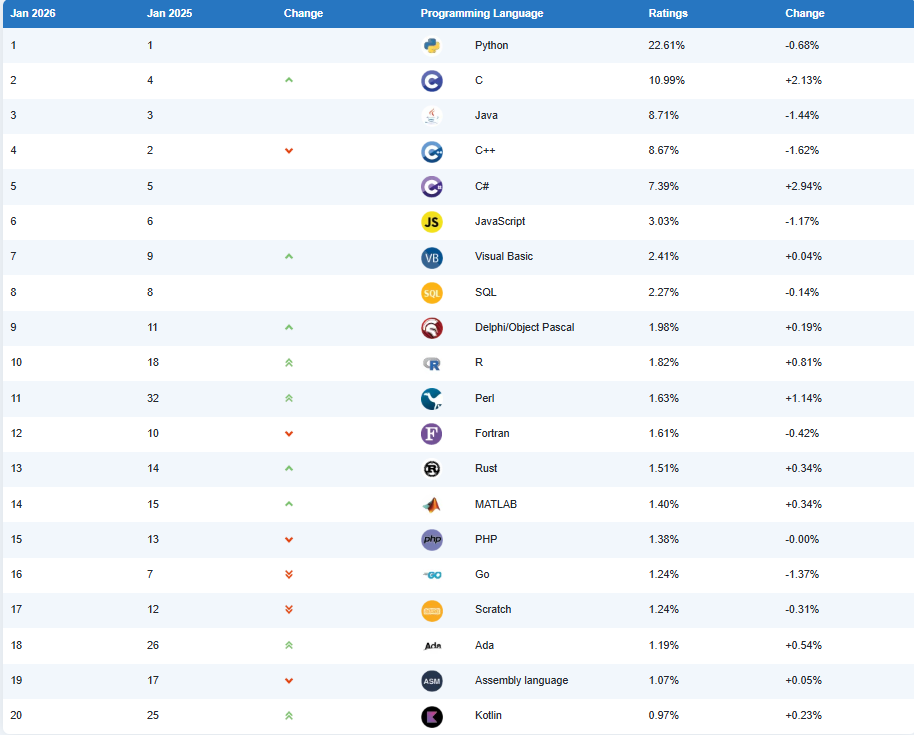
And let us look here also below at each language’s Trends in the Popularity of Programming Languages, also ranked by TIOBE:
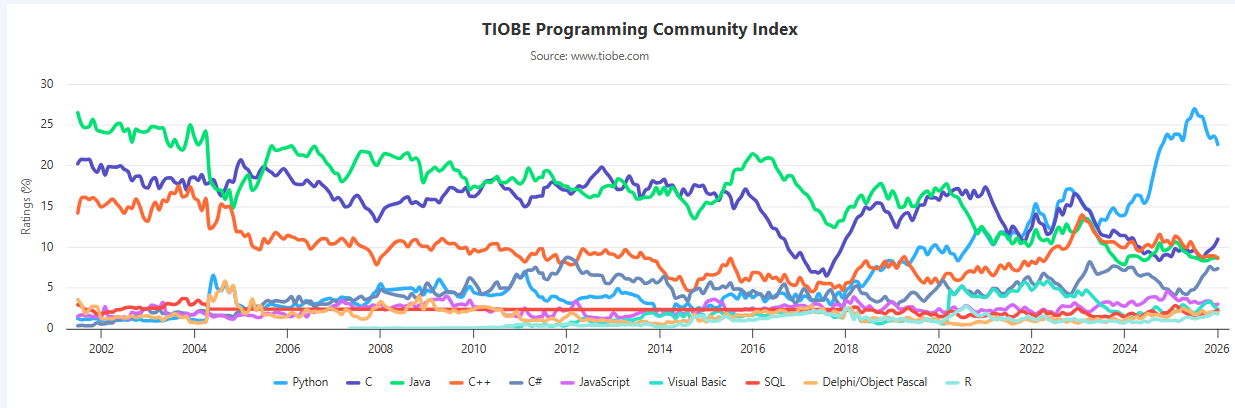
Can see above that based on TIOBE trends, as we can see that with AI becoming more and more popular, the Python language has made a strong push to the top without any doubt, but when we talk about the practical pros and cons of the popular web, I think I am afaid that I won't talk all of the 50 program languages, but we pick from among the topmost and relevant of the languages below that are truly worth discussing.
Truly Worth Discussing Programming Languages
Considering the programming languages truly worth discussing in 2026, I think they must be `Python`,`C/C++/Rust/Zig`,`C#/JAVA/GO`,`JavaScript(TypeScript/Nodejs/Bun.js/Deno.js)/PHP`,`Kotlin/Swift`.
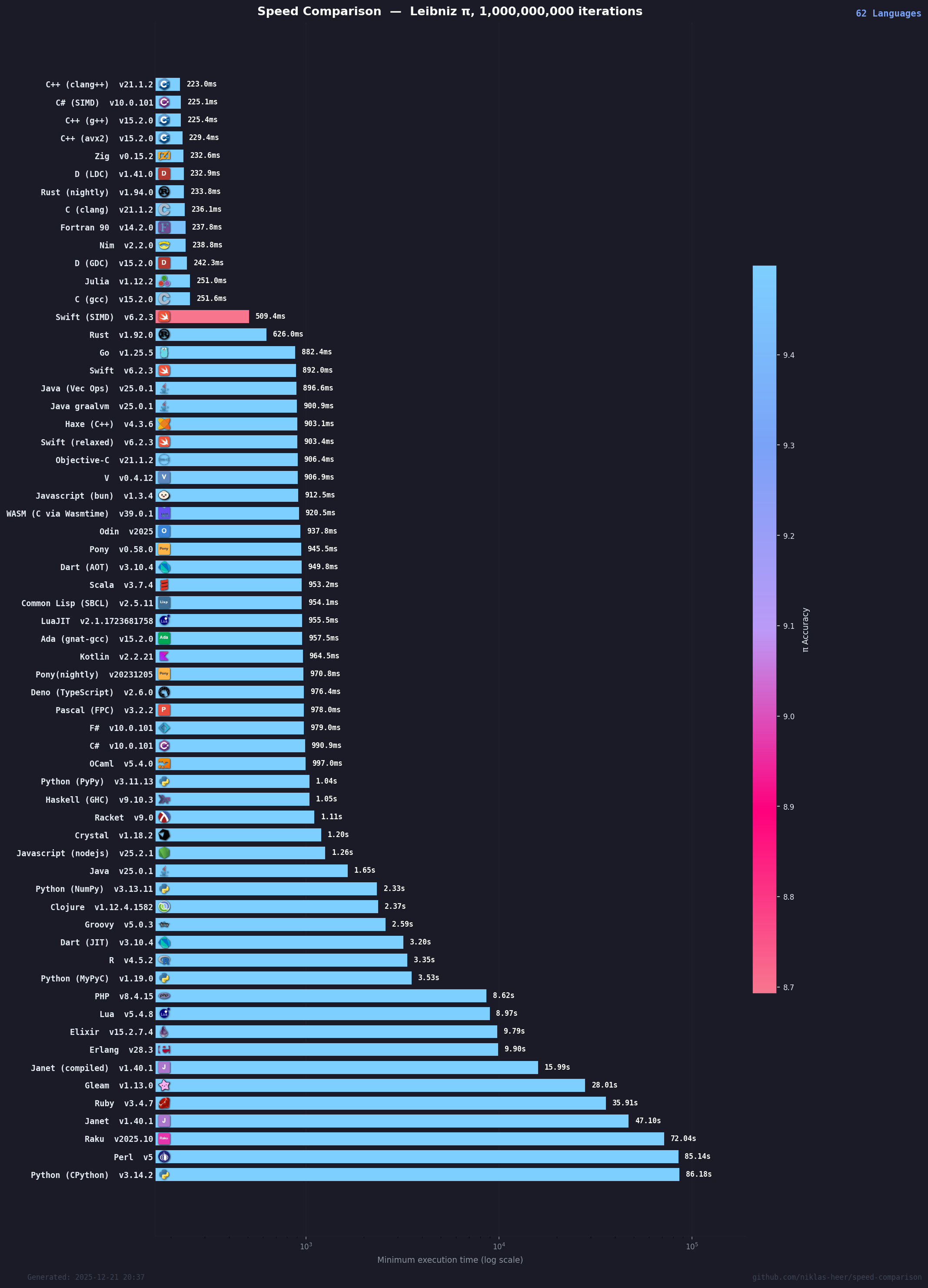
As you can see, for these languages, I group them together according to their common characteristics and functionality, and also based on similar factors they have in common that will shape our discussion about them. But before that, we can also have a preview on each languages running speed in the same situation here below, for which I think it will do a great favor for the understanding of the comparisons context, according to the popular github open source lib speed comparison by Niklas Heer. Here are the latest running result on 21 Dec 2025:
Python
When we talk about Python in today's world we are also talking about AI and there is no doubt this is the reason for its growth in usage.
Python is the most popular language for AI development due to several key factors:
- Simplicity and Readability: Python's syntax is clean, intuitive, and closely resembles human language. This reduces the learning curve for developers, allowing them to focus on solving complex AI problems rather than struggling with intricate code. It also makes code easier to write, read, and maintain, which is crucial for collaborative projects.
- Extensive Libraries and Frameworks: Python boasts a vast collection of powerful libraries and frameworks specifically designed for AI and machine learning. These include popular tools like NumPy and TensorFlow, which significantly speed up development and experimentation.
- Rapid Prototyping: The simplified and cleaner code structure of Python is ideal for fast prototyping, enabling developers to quickly test and iterate on AI models and solutions.
- Community Support: A large and active community contributes to Python's ecosystem, providing ample support, resources, and continuous development of new tools and libraries.
- Versatility: Beyond AI, Python is also widely used in web development, making it a versatile choice for developers working on various aspects of a project.
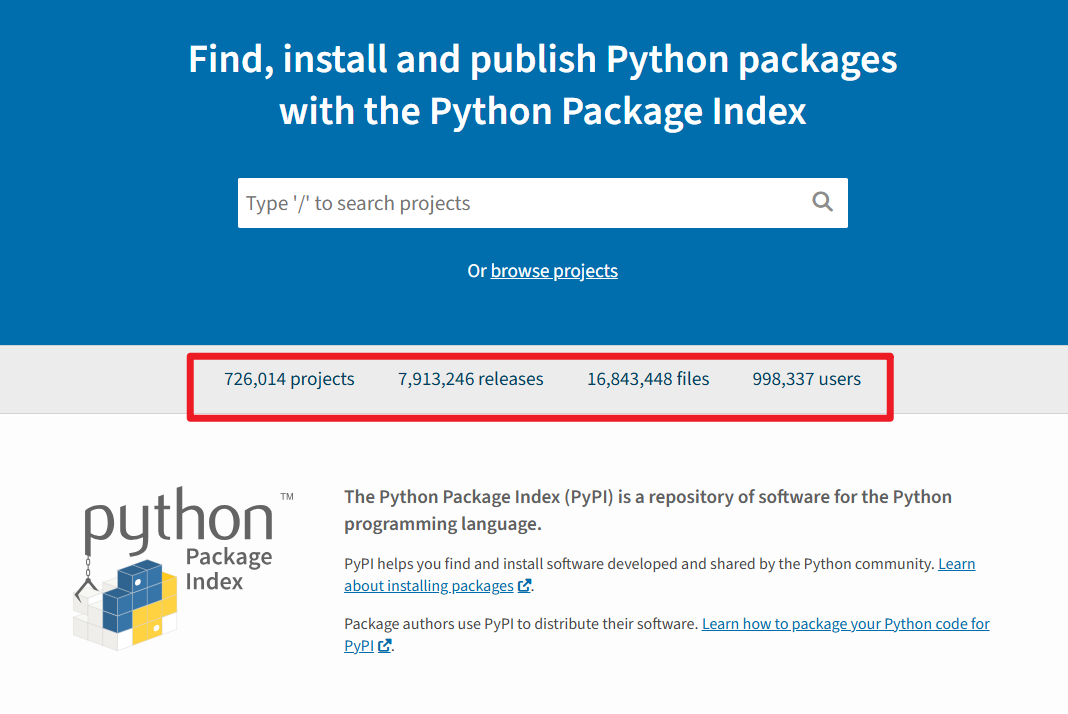
Despite its cons of the slower execution speed (see bottom of above chart) compared to compiled languages like C/C++, its limited use in mobile and client-side browser development, and Global Interpreter Lock (GIL) limiting multi-threaded parallelism - Python does have an easier and simpler syntax than most languages, is relatively easy to learn, has a vast and mature library/framework ecosystem (e.g., for AI, data analysis, although it's part of the libs was built based on the other language, like the `C`, and that's why the python also was called as an `script / glue ` language ), works well across platforms and operating systems, has a highly active community - the Python Package Index at pypi shows over `726,014` projects, `7,913,246` releases, `16,843,448` files, `998,337` users, and with AI gradually becoming more prevalent, there is no doubt that it will keep at increasing at the top rankings of programming languages for the foreseeable future.
C / C++ / Rust / Zig
The reason why I put the `C/C++/Rust/Zig` together to discuss is because they represent a necessary transition between old and new program languages. When we talk about the buiding of the `OS` level system building, we have to talk on the `C/C++`, as the most popular `OS` like the `windows/linux`, which was built mainly based on the `C/C++` (also have a lots others languges was used to build its ecosystem), which was the low-level language and gets closest to the hardware, and that's why the `OS` can go faster based on these language.
But the Cons are that whey are both pretty hard to learn and master, especially when it comes to the `memory management` - for the `C/C++`, we have to manage it manaully, and sometimes, when there are the `dangling pointers` during running, which will cause the unknown or crack error, especially for the OS, just like the `windows/Linux` system, which has been used as all king of the pruductions, it will be a huge disaster!
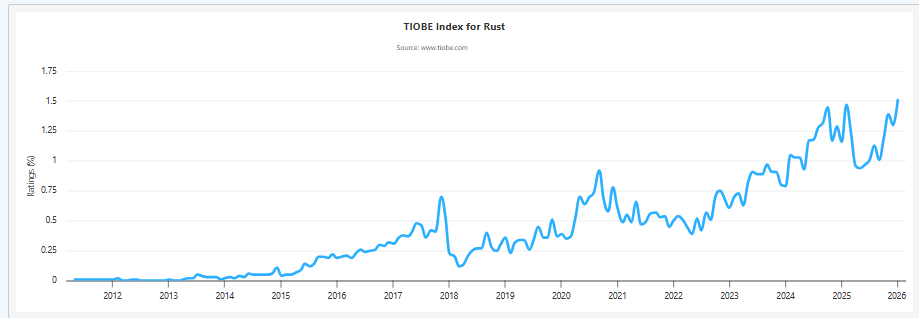
This is why in recent times `Rust` has come out with Memory safety (no garbage collector, no dangling pointers), High performance, comparable to `C/C++` (can reference to the Speed comparison table above), and also it has the Modern package manager and build tool (Cargo). But every language has its good aspect, but has the bad one as well, as Rust is pretty difficult to learn, and to make sure the code is as safe as possible, it will help to do the pre-compile every time when you want to publish or do the change to check out any errors to avoid any crack of the published system.
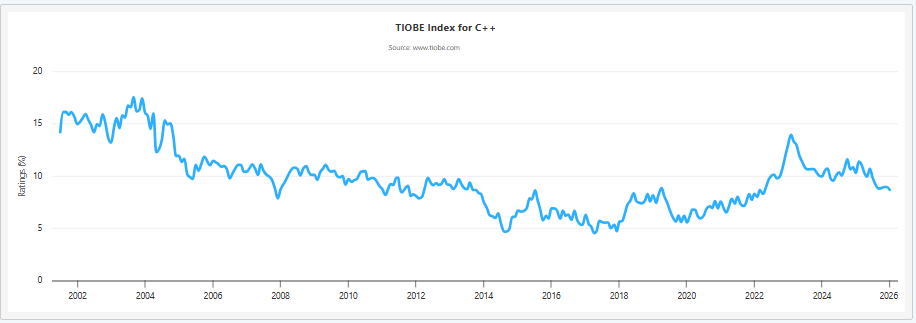
That's why it is going to become more and more popular, and a lot of the system tools and OS may be rebuilt with Rust, just like the company of the `Cloudflare` (according to their blog here), who have built their proxy named `Pingora` to replace its prior `Nginx` proxy with Rust, and that's why, as we can see, the languge of the `C++`'s trends in the `TIOBE` is going down nowadays being replaced with the newcomer.
Popularity over time for C++:
Popularity over time for Rust:
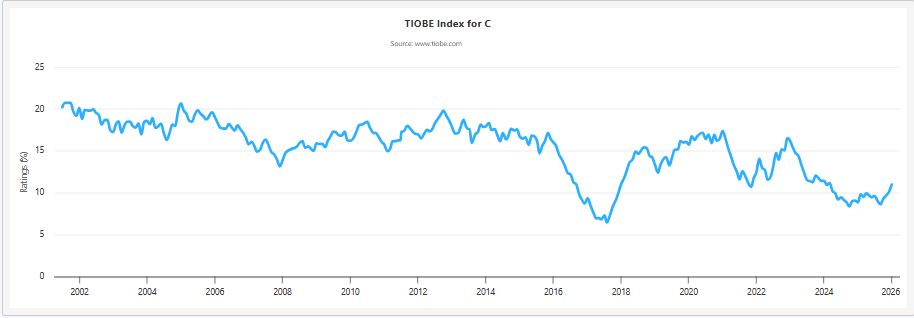
But considering this, you may be curious why `C` still stands second in the `TIOBE rankings`, that's because the C language (can be referred to as the "Portable assembly language"), provides the most direct, transparent, and controllable abstraction of hardware.
Its core is small and stable, almost unchanged for decades. A skilled C programmer can clearly predict the machine behavior of each line of code. This simplicity and predictability are the gold standards of system programming, and also for the other language like the `Python(CPython)` was built based on the `C`, even the core of the `Linux` was based on `C`. However, compared to the complexity and difficulty of `C` language, with the emergence of the `Zig` language, which are relatively simple compared to `C` language, they can replace `C` as a low-level language. Therefore, for `C` language, as `Zig` gradually grows stronger, it may be a potential adversary.
C# / JAVA / GO
As we can see, the `C/C++/Rust/Zig` languages have the low resouce consumptionand high performance, but they are pretty hard to learn, and when it comes to help build the businiess project, like some of the mid-large size website/desktop application building, whose frontend and backend is divided, some other choices may make more sense.
In this scenario, when it is important to work faster and build the stable minimum viable product, the `C#/JAVA/GO` would be one of the top choices, as they have a series of mature ecosystems, like the `Java`, whose `Spring Boot` framework has been the top choice for the traditialnal mid-size websites, especially in China, there were lots of the backend developer choose it as the first choice.
It's also famous as the `Write once, run anywhere`, as for the `C#`, when we want to develop a big game or the industrial systems, like the MES (Manufacturing Execution Systems), `C#` is the preferred programming language.
However, in recent years, due to its relationship with Google, the `Go` language has gradually caught up with or even replaced Java in the field of web development, with the advantages of starting quickly, less memory consumption, and being not so complicated as `Java`. As all of the `C#/JAVA/GO` are the representative of traditional object-oriented programming, they both have its running time and garbage collector, although they're not considered to have as high of performance and stability as the `C/C++/Rust/Zig` options, but it's much better than `Nodejs/PHP/Python` for the backend, and it's much easier to learn and master than `C/C++/Rust/Zig`.
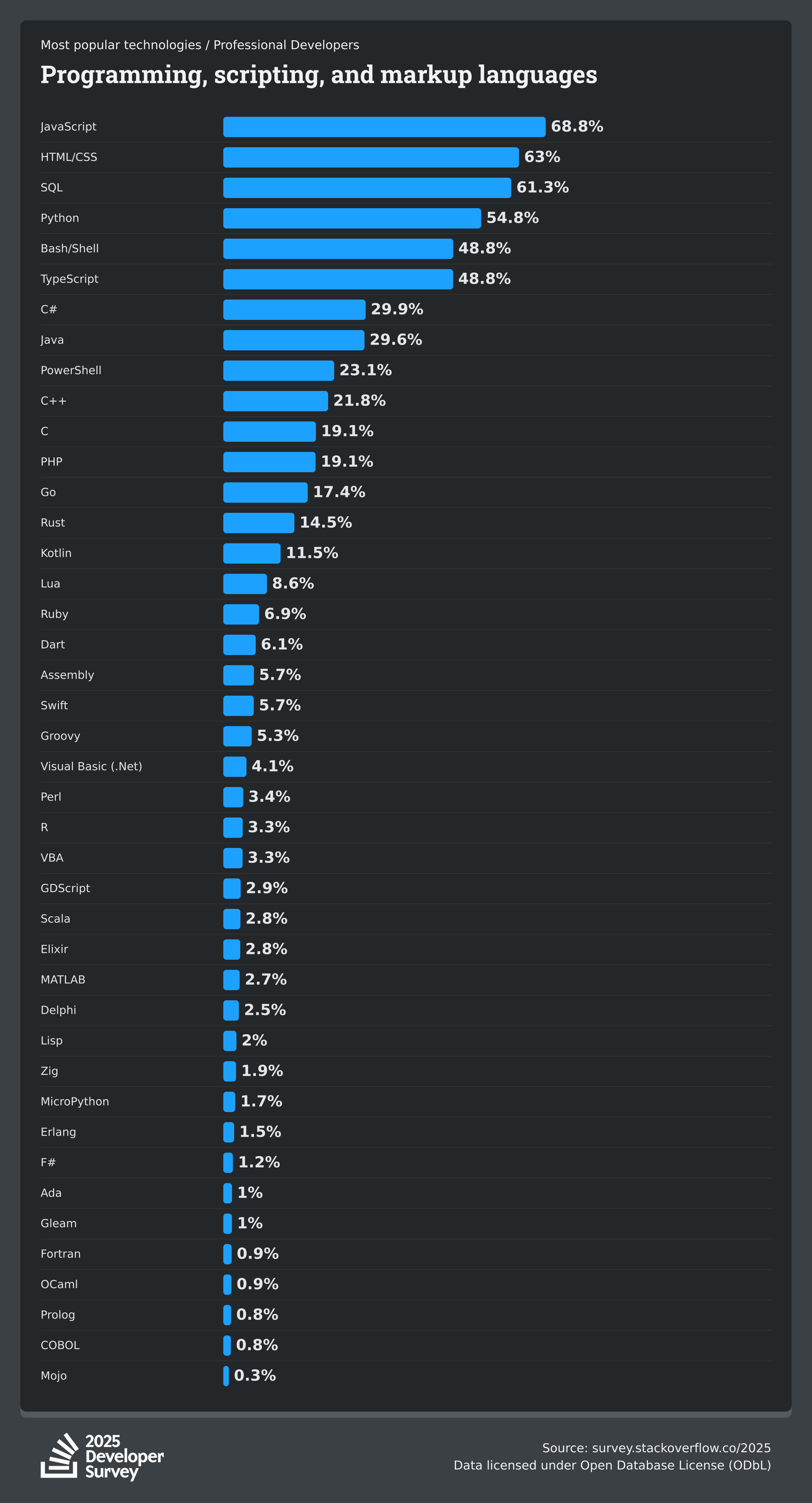
These reasons are why lots of developers will choose these as their first choice, although nowaday, with the assistence of the `AI`, to chase more stability and safety,lots of the developer may start to try with framework of the `Axum/Actix/Rocket` and etc, which was developed based on the `Rust`, but according to the StackOverflow research on the `Most popular technologies for 2025` for the developer, the `C#/JAVA/GO` are still preferred top choices.
JavaScript / TypeScript(/Nodejs/Bun.js/Deno.js) / PHP
If you are going to choose a framework to build a website of the small-middle size range quickly, like a website of the enterprise's official website or an AI startup's minimum viable product, I think the framework based on the `PHP` or the `Nodejs` is the best choice.
Why I talk about the `PHP` and `JS` together is because both of them are not fit for the big website with high `QPS` (queries per second), as their performance can't catch up with the `C#/JAVA/GO`, especially for the `PHP`, as we can see, which has many mature CMS and frameworks (e.g., `WordPress`, `Laravel`,`WooCommerce`、`Magento`), so if you want to quickly build a small website like a blog with the `WordPress` quickly, it will be an great choice, we can have developed it more easily with many mature and useful plugins. So in a short time frame, the availability of plugins and ready code frameworks help reduce the coding labor, and with the built themes, we're even just do the change for its contents. However, nowadays, with the tech development, it seems that the PHP was gradually abandoned,according to the `TIOBE Index` below:
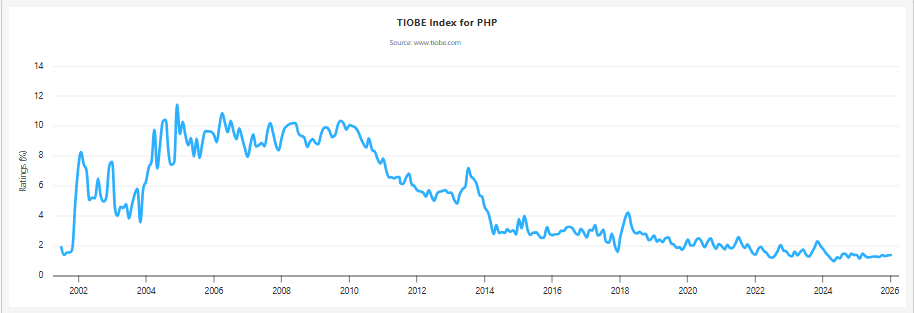
For the future, with the `AI` and `vibe coding` becoming more and more popular, for the market of the `PHP`, I think that it may be occupied by the full stack webframework based on the `JavaScript/TypeScript`, thus improving large project maintainability when using `JavaScript` with the types checking of the `TypeScript`, which can decrease a great number of errors.
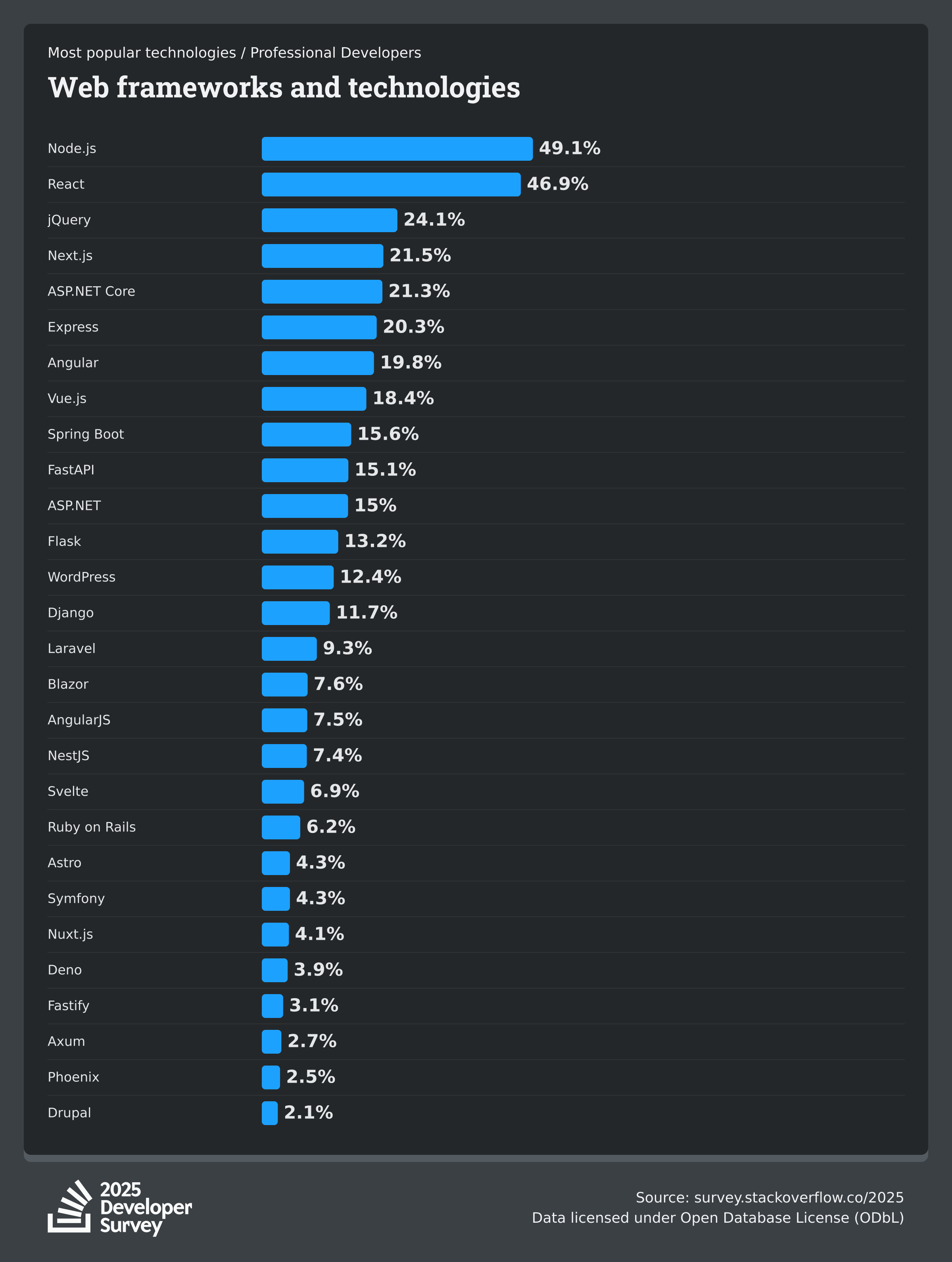
Just like the `Nextjs`,`Nest.js`, especially with the more safe JS run time of the `deno`, and less resource consumption but more faster run time of the `bun` occurred, based on these compiled running time, the programmer just needs to learn and master the web-building-required `html/js/css` coding, you can help build the small-mid-size website that you want, and that's why as you can see, more and more projects' MVP will be built with the `Nextjs`, espcially when it comes to the `Vibe Coding`, and also according to StackOverflow` research on the `Web frameworks and technologies` for 2025, the `nodejs/nextjs` was on the top.
Kotlin / Swift
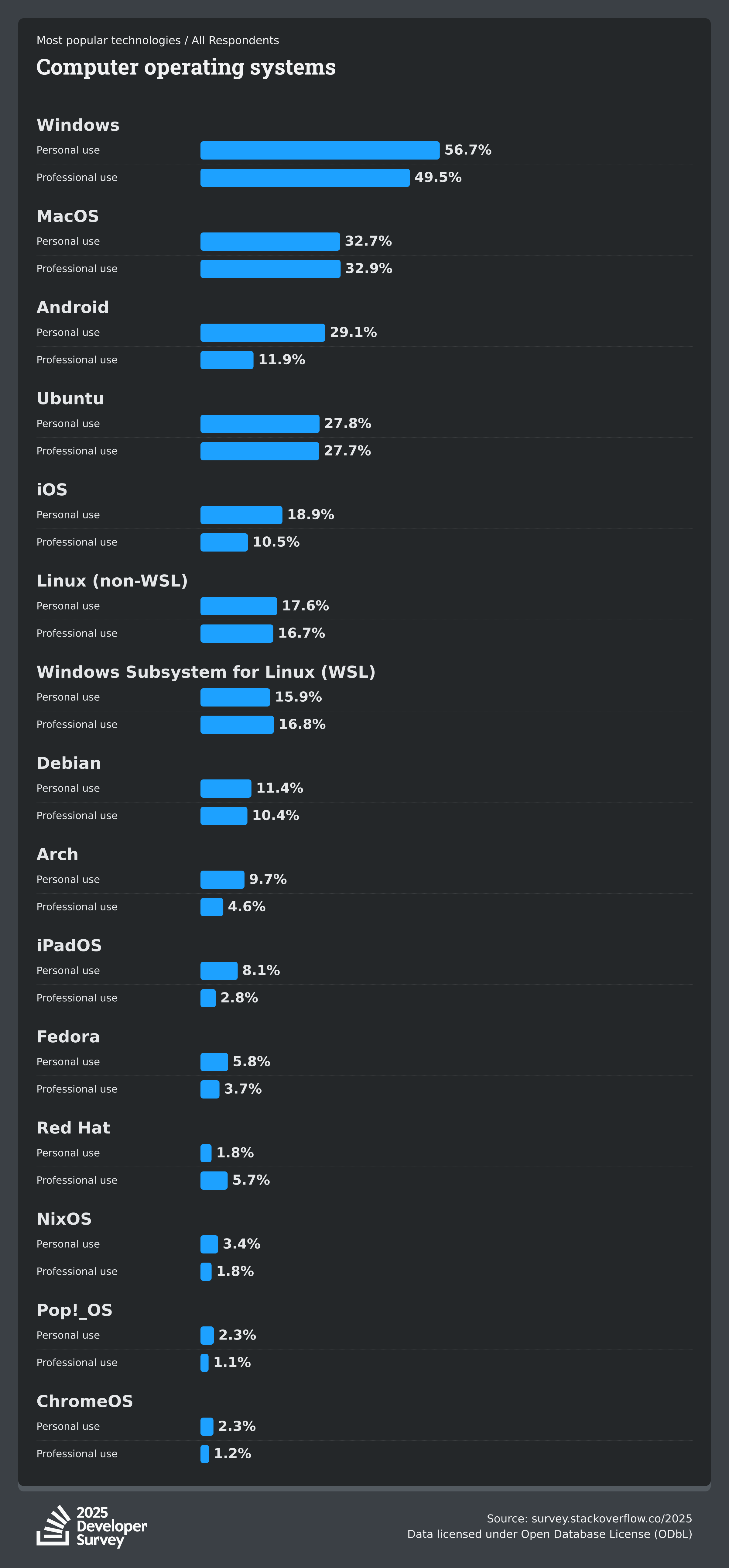
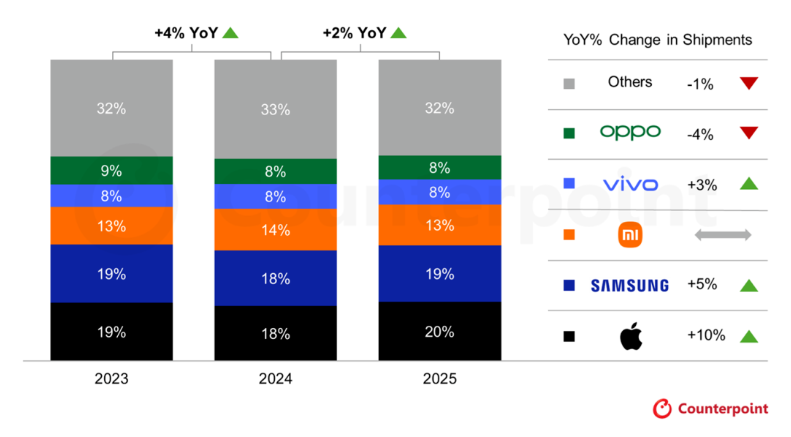
In the end I cover `Kotlin/Swift` because, the `Kotlin` is mainly saved for `Android` development, and `Swift` is used for the development of the `IOS`, so, I think there won't be so much discussion on them, but that depends on how many `Android/Iphone` were sold, and also according to the StackOverflow research on the `computer-operating-systems` for 2025 below combined the sales of the global phones, although the `iPhone` was the top, but the rest of the phones' OS (except the `HUAWEI`, which based on the `HarmonyOS`) was mainly based on the `Android`, so I think the `Kotlin` will still be more popular than `Swift`, however, as the platform of `React Native` becomes more and more mature, which can be used both on the `IOS` and `Android`, which maybe an potential challange for both of the `Kotlin` and `Swift`.
But as the `Swift` are safe syntax designed by Apple, has excellent interoperability with Objective-C, The dominant and recommended language for iOS, macOS, and other Apple platform development, its performance is highly optimized, so compared to the `Kotlin`, I think the `React Native` can't totally replaced the `Swift`, as long as iPhone was still on sale.
Also can observer mobile devices by manufacturer:
Summary
To show the `Pros` and `Cons` of the program languages more clearly, combined with the `Ranks` of the `TIOBE Index` for January 2026, here below I make a short summary table.
Apart from all of the `Pros` and `Cons` of the languages, I think that there should be a note for developers or IT project architects, saying that 'as far as the development of the program languages, there is no "best" programming language in the world, but there is the most suitable programming language for different projects. We only need to combine our own mastery and understanding of different languages to choose the most suitable one.' While keeping learning, we can go further and further on this career path.
Programming Languages - Rank, Name and Pros and Cons:
1. Python - 22.61%
Pros:
- Simple syntax, easy to learn;
- Vast and mature library/framework ecosystem (e.g., for AI, data analysis);
- Cross-platform;
- Highly active community
Cons:
- Slower execution speed compared to compiled languages like C/C++;
- Limited use in mobile and client-side browser development;
- Global Interpreter Lock (GIL) limits multi-threaded parallelism
2. C - 10.99%
Pros:
- High performance, close to hardware;
- Small and elegant core, highly portable;
- Foundational for system programming and embedded development
Cons:
- Requires manual memory management, prone to errors;
- Lacks modern abstractions (e.g., object-oriented);
- Standard library is relatively minimal
3. Java - 8.71%
Pros:
- "Write once, run anywhere" (JVM);
- Extremely rich and stable enterprise ecosystem and libraries;
- Automatic memory management
Cons:
- Verbose syntax;
- High startup time and memory overhead;
- Owned by Oracle, with some commercial licensing implications
4. C++ - 8.67%
Pros:
- Maintains C's high performance while supporting object-oriented and generic programming;
- Powerful Standard Template Library (STL)
Cons:
- Extremely complex syntax, steep learning curve;
- Manual memory management, security risks;
- New features (e.g., modules) slow to gain widespread industry adoption
5. C# - 7.39%
Pros:
- Elegant, modern syntax;
- Successfully shifted from Windows-only to cross-platform (.NET);
- Actively driven and innovated by Microsoft; Deep integration with Unity game engine
Cons:
- Historically tied closely to the Microsoft ecosystem;
- Slightly weaker historical presence and community influence on non-Windows platforms
6. JavaScript - 3.03%
Pros:
- The core language of all modern browsers;
- Extremely thriving ecosystem (Node.js, npm);
- Powerful asynchronous programming model
Cons:
- Dynamic typing can lead to maintainability issues in large projects;
- Cross-browser compatibility issues;
- Some early language design flaws
13. Rust - 1.51%
Pros:
- Memory safety (no garbage collector, no dangling pointers);
- High performance, comparable to C/C++;
- Modern package manager and build tool (Cargo)
Cons:
- Very steep learning curve (ownership, borrowing);
- Compilation time can be long;
- Still penetrating traditional C domains like embedded systems
15. PHP - 1.38%
Pros:
- Designed for web development, easy to start;
- Many mature CMS and frameworks (e.g., WordPress, Laravel);
- Easy deployment
Cons:
- Inconsistent language design has been criticized;
- Limited use outside web development;
- Generally slower performance than compiled languages like Java, Go.
16. Go - 1.24%
Pros:
- Simple syntax, fast compilation;
- Built-in powerful concurrency support (goroutines);
- Produces single executable, easy deployment
Cons:
- Lacked generics (added in 1.18, but ecosystem transition takes time);
- Smaller number of libraries compared to established languages like Java, Python
20. Kotlin - .97%
Pros:
- Fully interoperable with Java and more concise;
- Officially recommended by Google for Android development;
- Null safety reduces runtime crashes
Cons:
- Primarily active in Android and JVM ecosystems;
- Relatively limited market adoption in other areas like server-side
22. Swift - .91%
Pros:
- Modern, clean, and safe syntax designed by Apple;
- Excellent interoperability with Objective-C;
- The dominant and recommended language for iOS, macOS, and other Apple platform development;
- Performance is highly optimized
Cons:
- Primarily confined to the Apple ecosystem (iOS, macOS, etc.);
- Cross-platform support (e.g., for server-side or Android) is limited and not its primary focus;
- Language and API evolution can sometimes introduce migration efforts for existing projects
32. TypeScript - .32%
Pros:
- A superset of JavaScript adding static types, improving large project maintainability;
- Widely adopted by front-end frameworks (e.g., Angular,Nextjs)
Cons:
- Requires a compilation step; Can add complexity for small projects;
- Maintaining type definition files (*.d.ts) can be challenging.
42. Zig - .19%
Pros:
- Emphasizes simplicity, clarity, and performance;
- Can seamlessly integrate with and incrementally replace C code;
- No hidden control flow, good for predictable system software
Cons:
- Language and ecosystem are very young and not yet mature;
- Limited library and tooling support;
- Very small community and market share


 2026-06-15 - Cybersecurity
 2026-05-13 - Digital Marketing
 2026-03-11 - Cybersecurity