Search is not what it used to be. Nobody is typing three keywords into Google and clicking through ten tabs anymore. People are asking questions out loud or in a chat box, and they want one clear answer handed back to them immediately.
This is what tools like ChatGPT, Perplexity, Google AI Overviews, and Gemini are built to do. They do not show you a list and let you decide. They read the web, pull out the parts that matter, and write you a direct response. You never have to click anywhere.
This creates a real problem for us content creators and businesses. Ranking on Google used to be the goal. Now that is not enough. If an AI reads your content and decides it is too vague, too messy, or too hard to extract a usable answer from, it just moves on to someone else’s page. Your ranking means nothing at that point.
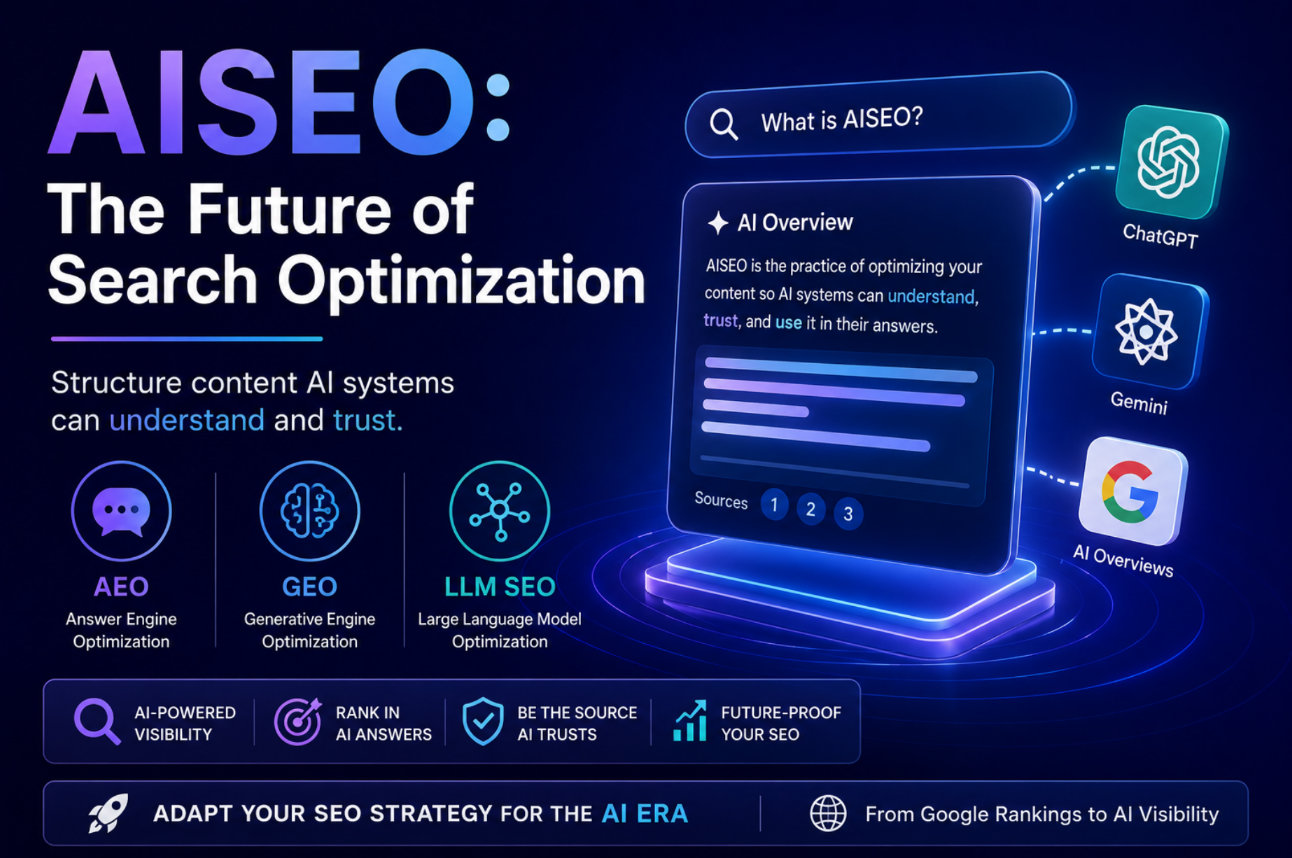
AISEO is the practice of fixing that. It is about making your content readable and trustworthy in the eyes of AI systems, not just search engine crawlers.
This guide breaks down what AISEO actually is, why it has become urgent, and how to approach it practically.

What is AISEO and Why is it Critical Now?
AISEO stands for AI Search Engine Optimization. The concept is simple: write and structure your content so AI systems can understand it, trust it, and use it in their answers. It sounds similar to regular SEO, but it is not. Traditional SEO is largely a game of keywords and links. AISEO is more about comprehension. Can the AI actually make sense of what you wrote? Can it extract a clean, accurate answer? Is your content deep enough on the topic to be believable?
Why is this important now? It’s the numbers. In a 2026 report, it was found that approximately 27% of all search queries are now being answered by AI systems instead of a traditional results page. A separate study recorded over 50% growth in AI-driven search traffic in a single year. These are not small shifts. This is a fundamental change in how people find information, and it is happening fast. Content that was built purely for Google rankings is already starting to underperform. If your pages are not written in a way that AI systems can parse and trust, they simply will not show up in the answers millions of people are reading every day.
How Traditional SEO and AISEO Differ?
They are both about visibility, but they operate on a very different logic.
Traditional SEO
Traditional SEO is built around getting pages to rank on Google or Bing. You optimize for keywords, earn backlinks from reputable sites, fix technical issues like load speed and mobile compatibility, and craft your titles and meta descriptions carefully. Search engines use crawlers to index your pages. When someone makes a search, the algorithm ranks those indexed pages based on relevance, quality, authority, and technical health. The better your score across those factors, the higher you appear. Higher placement means more traffic. That has been the core loop for over two decades.
AISEO
AISEO works differently. It focuses on what happens after indexing, specifically on how AI systems interpret, summarize, and reuse your content when generating a response. There are three main branches under the AISEO umbrella.
AEO (Answer Engine Optimization)
AEO is about writing content that answers specific questions cleanly and directly. Answer engines do not reward you for writing long, winding articles. They scan for the part that actually responds to the query and pull it out. That means formatting your content around real questions people ask, keeping explanations tight and free of filler, and structuring sections so they are easy to extract independently. It also means understanding exactly what someone wants when they type a particular search, and making sure your content delivers that specific thing. AEO matters most for voice search, AI assistants, and featured snippets where there is only room for one answer.
GEO (Generative Engine Optimization)
GEO is about preparing your content for the AI systems that actually generate written responses rather than display links. These systems do not pick one source and quote it. They pull from multiple pages, blend the information together, and produce a single, conversational answer. Your content needs to be easy to extract and easy to combine with other sources. Clarity is the main spotlight here. A page that touches on one narrow angle of a subject is less useful to these systems than a page that covers the topic with depth and context. The goal is to be a source the AI draws on regularly, even when the user never visits your site directly.
LLM SEO (Large Language Model Optimization)
Large language models do not just index content. They learn from it. They pick up patterns, context, and relationships between ideas. LLM SEO is about making your content the kind of material these models can actually learn from and reliably reference. That requires depth. Shallow content that skims the surface of a topic is not going to build the kind of context a language model needs. It also requires writing with clear references to relevant entities, whether those are specific tools, people, brands, or concepts, and explaining how those things relate to each other. Natural, conversational language helps too. And clarity reduces the chance that the model will misinterpret your content or use it incorrectly. The objective here is not one page ranking for one keyword. It is your content becoming part of how an AI explains you subject to people.
Five Steps to Put AISEO Into Practice
Step 1: Get Clear on What you are Actually Trying to do
Pick a direction before you start optimizing. Are you trying to grow organic traffic? Get cited in AI-generated answers? Rank for competitive queries in your niche? All of the above? Vague goals produce vague results. Clear goals give you something to measure against. Once you have the goals, study how your audience searches. What questions do they ask? What language do they use naturally? What are they actually hoping to find? AI search systems are built around intent, not keywords, so the better you understand what your audience really wants, the better positioned your content will be.
Step 2: Write Content That is Actually Useful
This sounds obvious. It is not always practiced. Good AISEO content is direct, well-organized, and genuinely informative. It uses clear headings. It answers questions without burying the answer in three paragraphs of preamble. It is structured so that any section can be pulled out and understood on its own. Write like a person, not like a keyword strategy. AI search engines understand context and the relationships between ideas. Forcing repetitive phrases into your content does not help. Writing naturally, in a way that actually helps readers, does.
AISEO Content Best-Practices
Below are the five structural techniques that make content easy for AI systems to parse, extract and trust:
Chunking
- The problem is that it’s hard to get people to care. Each section should be stand-alone with a single clear point, full context and able to be extracted without the rest of the article. If an AI were to pull that section alone to answer a query, it should still all make sense.
Informative Headings
- Don’t use clever or vague headings. Use clear, direct, descriptive subheaders that correspond to the language your audience actually uses when searching. “How to Fix Slow Page Load Speed” will always trump “The Need for Speed” for readers and AI systems alike.
Numbered steps and lists
- AI systems like structured formats. Dense prose is more difficult to extract and reuse than step-by-step guides, bullet lists, and numbered sequences. If your content is logically ordered or a set of discrete items, format it explicitly as such, rather than hiding it in paragraphs.
Table
- Use tables for comparisons, feature breakdowns and summary overviews. A well-structured table immediately communicates relationships between data points, both for human readers and for AI systems pulling structured answers.
Pillar + Cluster Model
- Create your site with a pillar page that covers a broad topic in depth, and cluster pages that cover more specific subtopics in depth. Link them in both directions. This architecture enables AI systems to comprehend the topical relationships across your site, cite multiple pages as authoritative sources, and build a clear picture of your entity authority on the subject.
None of these approaches requires a complete rewrite of the content. Apply all five to the next piece you put out. You will notice a difference in the clarity of the reading, and so will the AI.
Step 3: Fix The Technical Foundation
Content quality only matters if the website it lives on works properly. Slow loading, broken links, poor mobile experience, and confusing site structure all drag down your performance in AI search, just as they do in traditional search. Schema markup and structured data are worth investing in. They give AI systems clearer signals about what your content is about, what entities are involved, and how information is organized. This makes it easier for you to get your content into featured snippets, voice search results, and AI-generated summaries.
Make Content Visible Without JavaScript
AI crawlers often don’t execute JS, so if your reviews, FAQs, or product descriptions are client-side rendered, they may be simply invisible to the systems you’re trying to reach. Fix this before it messes everything up.
Make sure important content is available in raw HTML, if it’s not in the page source, AI can’t see it. Test with JavaScript disabled, open your page with JS disabled and see if your key content still loads. What is lost is what the AI misses.
Don’t do reviews, descriptions, FAQs that are just JS. Those are the types of high-value content that AI systems are targeting. Making them server side is a small technical fix with great impact on visibility.
Step 4: Use AI Tools, But Don’t Give Up Control
AI tools for keyword research, content idea generation, and performance tracking are useful. They can identify holes in your coverage, suggest new angles, and really speed up your research. The downside is getting too reliant. AI-generated content that goes straight to publish without a human reviewing it tends to be repetitive, sometimes inaccurate, and lacking the kind of specific voice that builds reader trust. Use AI to accelerate your process. Keep a human in the loop to make sure what goes live is actually good.
Step 5: Treat Optimization as Ongoing, Not a One-Time Job
AI search algorithms change constantly. What worked well six months ago may not be the approach that works today. Monitoring your performance regularly, across organic traffic, engagement, rankings, and conversions, is the only way to know what is actually happening. Update old content when the information is stale. Revisit your keyword strategy when you see a drop. Pay attention to how AI search behavior is evolving and adjust accordingly. The sites that stay visible long-term are the ones that treat optimization as a discipline, not a project.

Mistakes That Kill AISEO Results
Publishing Unedited AI Output
- AI writing tools are fast. But unedited AI output tends to be generic, hedged, and flat in a way that both search systems and real readers notice. Treat AI drafts as a starting point. Editing with actual subject-matter knowledge is what produces content worth publishing.
Chasing Keywords Instead of Intent
- A page can tick every keyword box and still fail completely because it does not give users what they actually wanted. AI search systems are specifically designed to evaluate intent. Pages that do not match what users were hoping to find experience higher bounce rates and lower visibility, regardless of keyword density. Ask what problem someone is trying to solve before you write a single word.
Ignoring Technical Problems
- A slow site with broken links is a slow site with broken links, regardless of how good the writing is. Technical SEO is the foundation that everything else sits on. Without it, great content gets wasted. Structured data is worth special attention here. Many sites skip it entirely, and it is one of the clearest signals you can give to AI systems about what your content actually covers.
Forcing Keywords Into Content
- AI search engines are sophisticated enough to recognize when you are repeating a phrase unnaturally. Keyword stuffing does not fool them. It annoys human readers and can actively hurt your rankings. Keywords belong in content the way they would appear in any well-written article on the topic: naturally, as a byproduct of covering the subject well.

What Changed in 2026? The Death of FAQ Rich Results
On May 7, 2026, Google officially removed FAQ rich results from search. The expendable question-and-answer dropdowns that used to appear under listings disappeared completely, across every industry and every type of site. This was a long time coming. The phase-out started years earlier and was slow and deliberate.
The Timeline
The slow death started years before the final removal:
- August 2023: FAQ rich results restricted to government and health domains only, cutting off nearly every commercial site.
- September 2023: HowTo rich results disappeared from desktops.
- March 2026: Tracking tools reporting near-zero impressions.
- May 7, 2026: Gone completely.
Why Google Did It
The feature got abused, badly. Websites started using FAQ schema purely to grab more real estate on the results page. The questions were stuffed with keywords. The answers were promotional, irrelevant, and generated by AI with no quality control. Some sites hid FAQ content from users while still serving it to search engines. The result was a cluttered, low-trust feature that stopped serving users. Google pulled it.
What It Actually Signals
The FAQ removal is a symptom of something bigger. Google is moving toward AI-generated answers and away from traditional structured SERP features. The "optimize for a specific feature to gain visibility" playbook is losing ground.
What's replacing it: topical authority (covering your subject with real depth), entity clarity (being specific about the brands, people, and concepts you reference), semantic relevance (writing for what users actually mean, not just what they type), and genuine credibility. Gaming features is out. Being useful to the AI deciding what users see is in.
Where Search Is Going and What To Do About It
AI-powered search isn't going to plateau at some comfortable level. It's accelerating. The way people find information is being restructured around tools that synthesize answers directly, and that changes what it means to have visible, valuable content online.
To be blunt, most content teams I've seen are still operating on a 2022 playbook. They're writing for crawlers, optimizing for features that are disappearing, and measuring success by rankings that don't translate to traffic the way they used to.
The adjustment isn't complicated, but it does require a mindset shift. Stop writing for algorithms. Start writing for the AI that's going to decide whether your content is worth surfacing to a real person.
If you want a place to start: audit one piece of your existing content this week. Ask yourself, if an AI read only this page, could it extract a clear, trustworthy answer to the question it's supposed to address? If not, that's your first fix.
That is the bet worth making. Investing in AISEO now, before it becomes a universally understood standard, is how you hold your ground as search continues to evolve. If you’ve been reading this and realized your own site needs to be optimized, recognizing the invisible traffic and the content that exists but doesn’t get used, that’s the sign to act now rather than later. Visit https://seirim.com/en/services/digital-marketing to see how we work and get in touch.